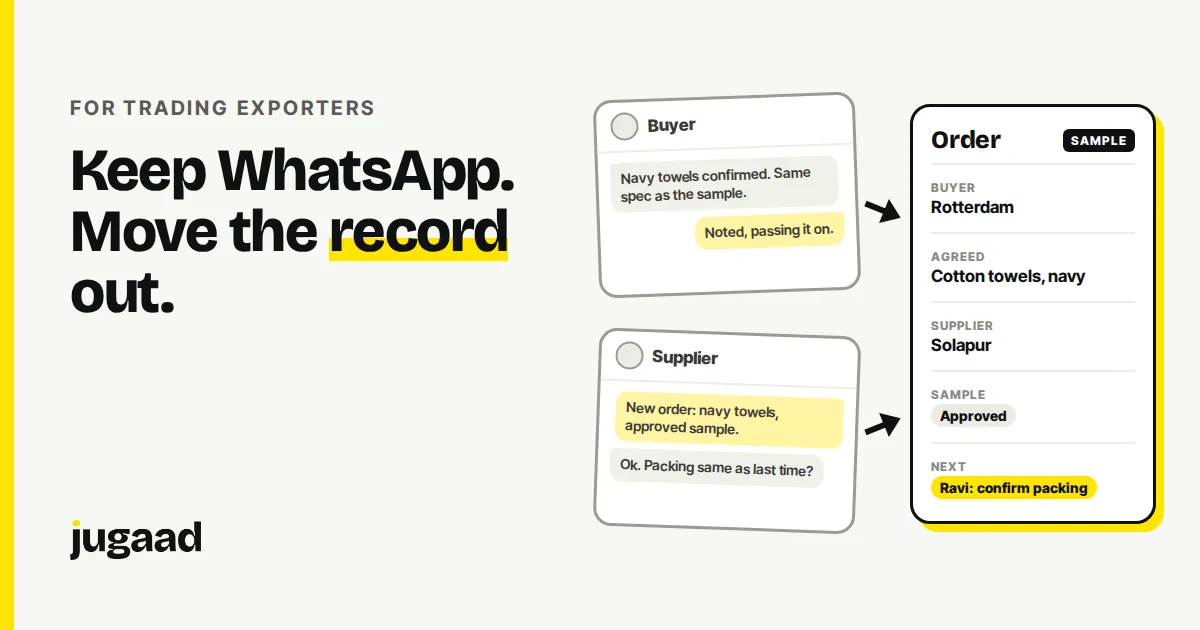
If you export goods you do not make yourself, your business sits between two sets of chats: your suppliers and your buyers. Most trading exporters run both on WhatsApp, and it works until the order count grows. This post covers what breaks, what to move out of chats first, and how to handle export order management on WhatsApp without a big project.
Why WhatsApp works so well for a trading exporter
Buyers abroad message you there. Suppliers answer there. Photos of samples, a quick price check, a packing confirmation: it all takes seconds.
That speed is the reason to keep WhatsApp. The problem is not the app. The problem is that a chat is a conversation, and an order is a record.
What breaks as orders grow
A trading exporter has a harder job than a manufacturer in one way: the order passes through hands you do not control. Here is where it slips.
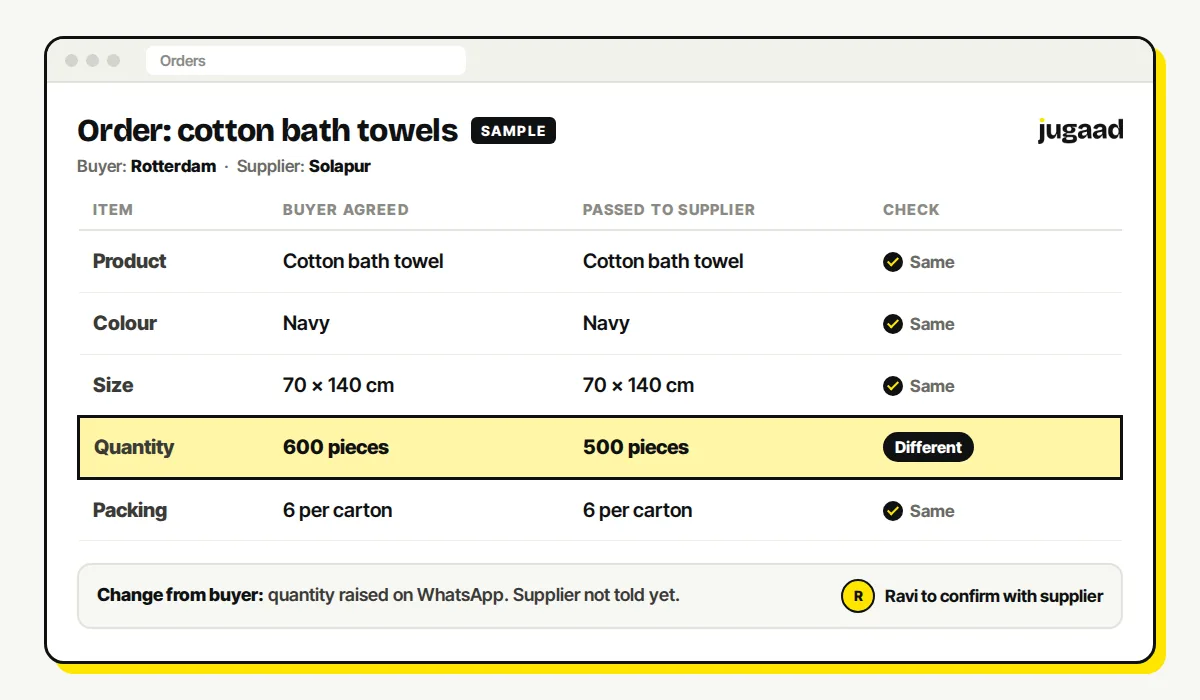
The buyer's order and the supplier's order drift apart. The buyer confirms one spec in one chat. You pass a slightly different version to the supplier in another. Nobody notices until the goods are ready.
Prices and quantities live in scrolling. To find what you agreed with a buyer in July, you scroll. To find what the supplier quoted you, you scroll somewhere else. Margin on an order is then a guess until someone sits down with both chats.
Changes arrive but do not land. A buyer changes the quantity. You read it, you mean to tell the supplier, and the day gets busy.
Samples and approvals get lost. Which sample did the buyer approve? Which version went to the supplier? The photo is somewhere above a hundred other messages.
The status is in one head. You know which orders are waiting on a supplier, which on a buyer's payment, which on a document. Your team has to ask you. When you travel, work slows down.
An order is not a chat: what to record
Start with one record per order. Seven things cover most of it:
- Buyer and order reference. Who ordered, and your own order number.
- What was agreed. Product, spec, quantity, price, and the date it was agreed.
- Supplier and what you passed on. Which supplier is making it, and the exact spec and quantity you gave them.
- Approvals. Sample or artwork approved, by whom, on what date.
- Dates. Supplier ready date, shipment date, payment due date.
- Changes. Each change, who asked, when, and whether the supplier has acknowledged it.
- Next action and owner. One named person, one thing, one date.
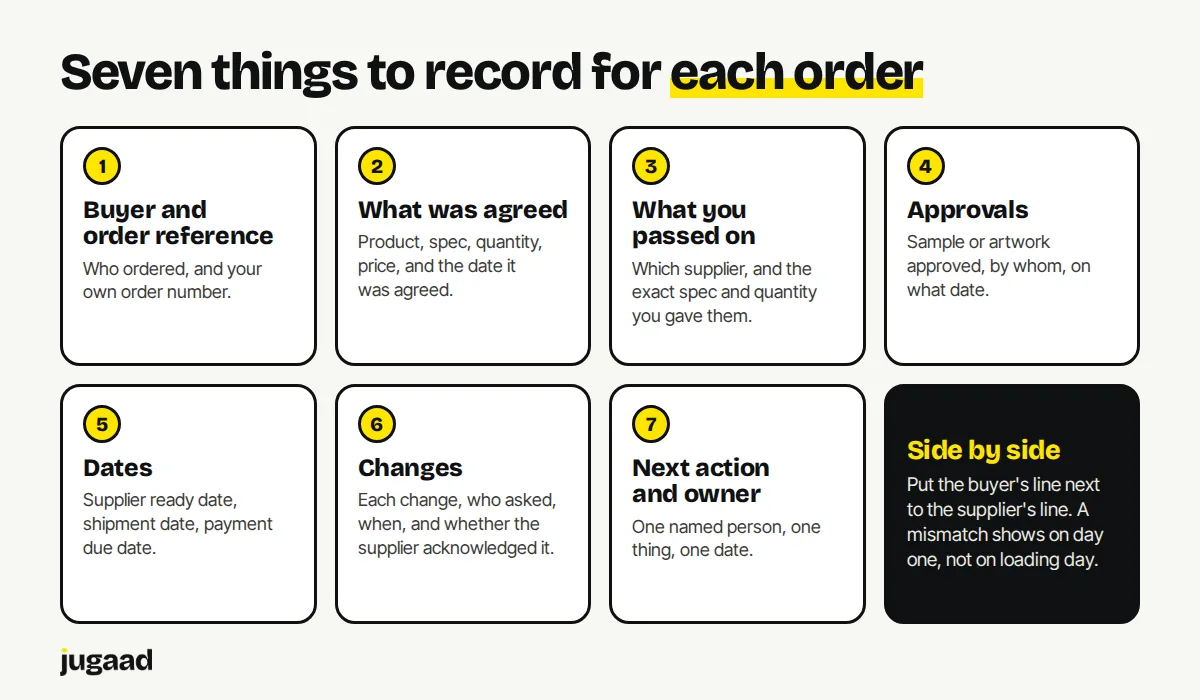
If the buyer's line and the supplier's line sit side by side, a mismatch is visible on day one, not on loading day.
Keep WhatsApp. Move the record out of it.
Nobody needs to stop messaging suppliers or buyers. The shift is smaller than that:
- The chat stays for talking.
- The agreed numbers and dates go into the order record.
- The team looks at the record to see status, instead of asking you.
Once this works, the system can send the reminders. A supplier ready date that is two days away, or a payment follow-up that is due, shows up on its own without anyone having to remember.
Where Excel fits, and where it stops
Excel is a fair first step. One row per order is better than a chat. Its limit is that it only holds what someone types in, and it does not know that a change to the buyer's quantity should show up against the supplier's order. It also does not remind anyone, and it does not show who changed a cell.
If you are already at one sheet per buyer, or two people editing the same file, you have reached that limit. Our post on the signs you have outgrown Excel and WhatsApp lists more of them.
What stays where it is
Accounts, GST and invoices can stay in Tally or whatever you use now. An order system sits next to them and can connect to them. Export documents and shipment status after the goods leave are a related job. We will cover that in a separate post.
How to start
Do not move the whole business at once.
- Pick your ten next orders, or the orders of your biggest buyer.
- Write down the seven things above for each one, in the same format.
- Note every question you had to answer by scrolling a chat.
- Build a small system for just that. See it work. Then grow.
More on what we build for exporters: software for export businesses, and for traders and distributors.
If an existing product already does this well for you, use it. We will tell you so on the call. There is no discovery fee.
FAQ
Can I keep taking orders on WhatsApp? Yes. Buyers and suppliers can carry on exactly as they do now. Your team enters the agreed details in one place, and that becomes the reference.
Do I need to change how my suppliers work? Not to begin with. They keep using WhatsApp. What changes is that you have your own record of what you asked them for.
Is this a replacement for Tally? No. Accounts and GST stay where they are. An order system covers what accounts software was not built for: specs, changes, dates and follow-ups.
How long does it take to build? We aim for weeks, not months, by starting with one process. The exact time depends on your process, and we can tell you after a short call.
Next step
Tell us what wastes the most time in your business. Fifteen minutes is usually enough to know whether it is worth building.
Book a 15-minute call. No obligation. No pitch deck.
You can also reach me on WhatsApp at +91 98300 90897, or write to atish@jugaad.sh. I answer directly.
Atish Kejriwal, Founder, Jugaad Studio