You can buy a readymade ERP, or you can have one built around your process. Neither is always right. This post gives five questions to help you decide, and says plainly when a readymade product is the better choice.
If you want the basics first, read What a custom ERP actually is.
The short answer
Choose a readymade ERP if your business works the way most businesses in your line work, and you are happy to adjust your process to the software.
Choose a custom ERP if your process is different from the standard, and the difference is why customers choose you.
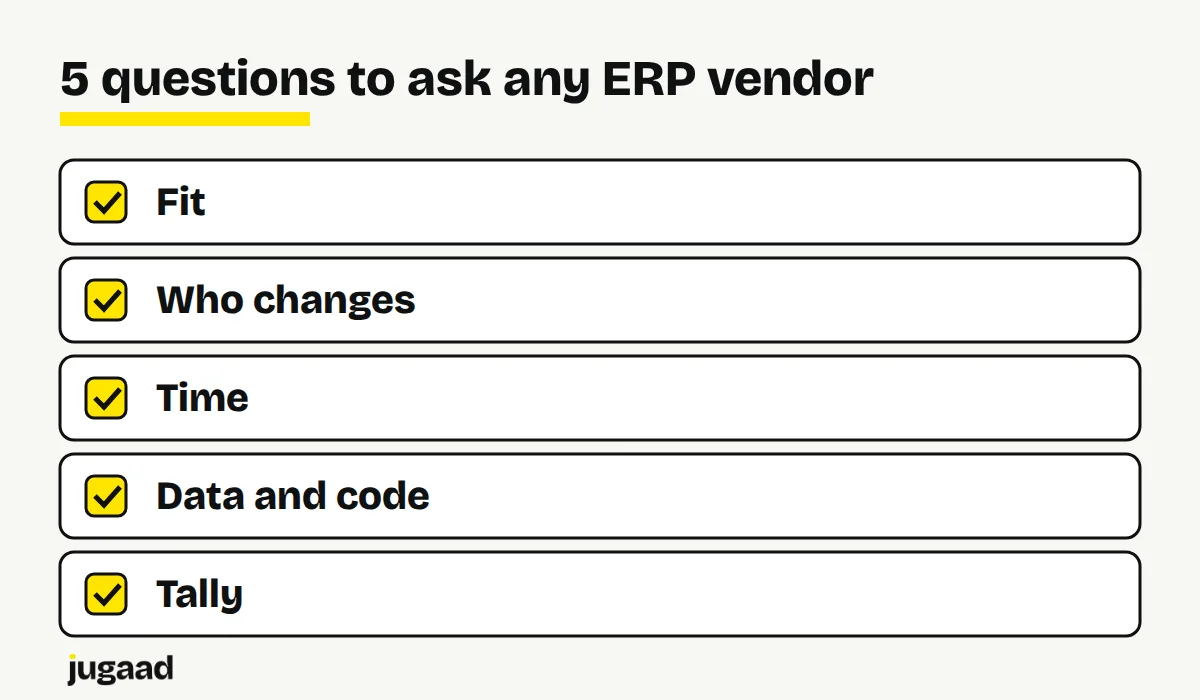
Many businesses are somewhere in between. The five questions below help.
Five questions to ask
1. Does the software fit how you really work?
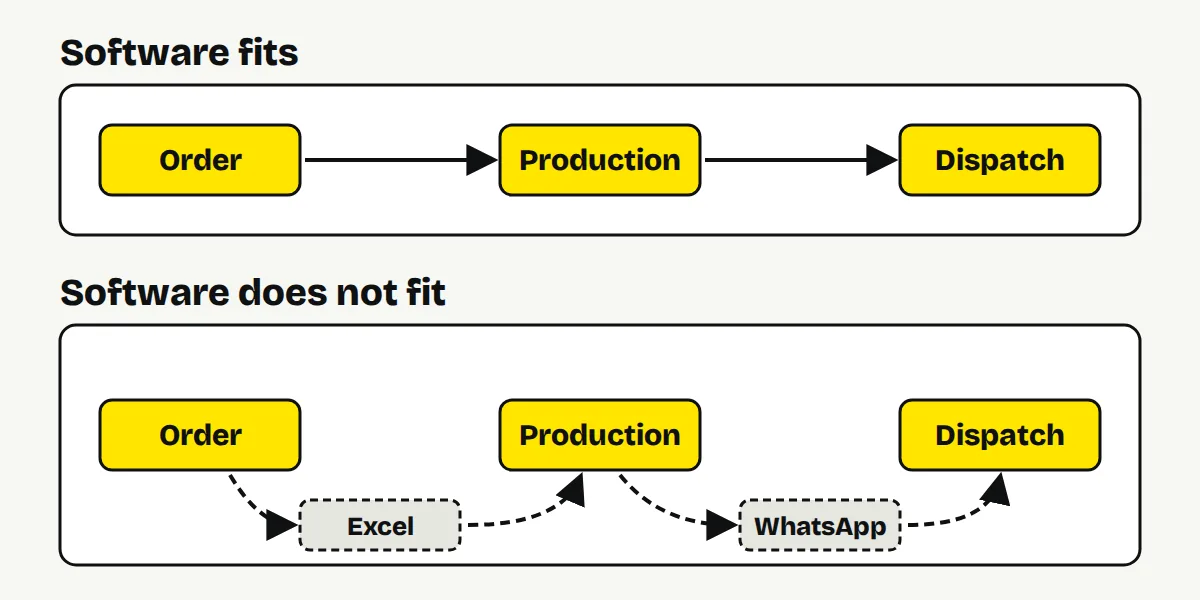
Write down how one order moves through your business, from enquiry to dispatch. Then watch a demo of the readymade product with your order in mind.
If the product handles the steps as they are, that is good. If you would have to change a step that works well for you, ask why.
Our own examples show how different businesses can be. A garment maker with vendors doing embroidery outside needs stages locked one after another. A PVC door factory that builds every order to a custom spec needs the spec captured once and visible to the person cutting. A readymade package built for a general business may not model either.
2. Who will have to change: you or the software?
With a readymade ERP, you usually change your process to fit. Sometimes that is healthy, because a standard process can be better than the one you grew into.
When the change does not fit, people find workarounds. The workarounds go back to Excel and WhatsApp. Now you have the ERP and the spreadsheets, and more work than before.
3. How long can you wait?
Readymade packages often come with a long implementation. We aim to deliver custom systems in weeks, not the nine-month ERP project, by starting with one process. The exact time depends on your business.
4. What happens to your data and code?
Ask both kinds of vendor three things:
- Do I pay per user, and what happens to the cost when my team grows?
- Can I export all my data whenever I want?
- Who owns the code?
With us, there is no per-seat licence and no lock-in. You own the code and the data. You can export your data or hire another developer at any time. Whichever vendor you choose, get the answers in writing.
5. Does it work with Tally?
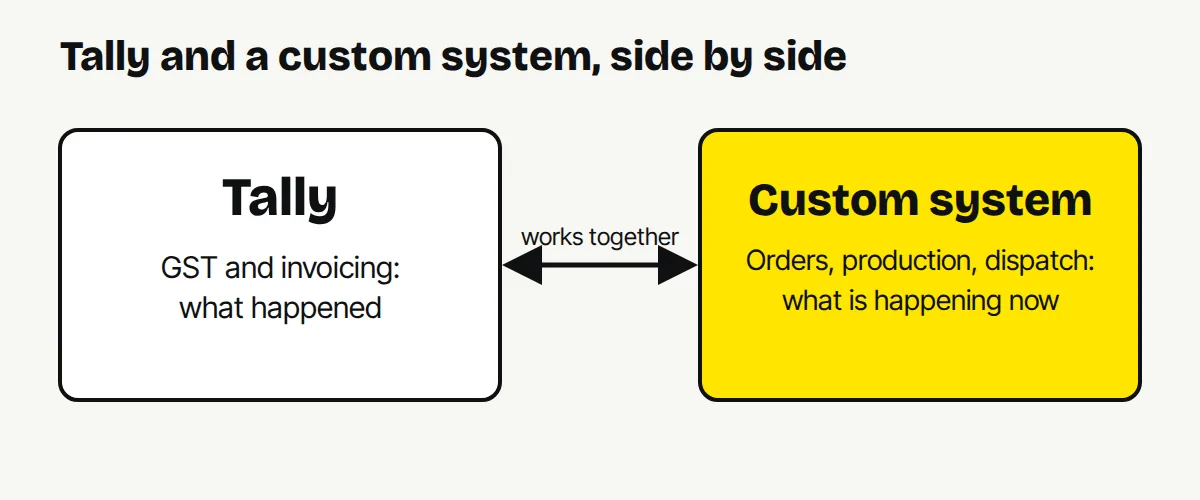
Most Indian businesses keep GST and invoicing in Tally. A custom system does not have to replace it. We integrate with Tally. Tally records what happened. A custom system helps you run what is happening right now.
If you consider a readymade ERP, check how well it connects with Tally and with the sheets and WhatsApp flows your team already uses.
Custom vs readymade at a glance
| | Readymade ERP | Custom ERP | |---|---|---| | Fit with your process | You adjust to the software | Built around your process | | Time to start | Depends on the product and the implementation | Weeks, starting with one process | | Licence | Often per user | No per-seat licence with us | | Code and data | Depends on the vendor | You own both with us | | Changes later | Within what the product allows | New modules added as you grow | | Best when | Your process is standard | Your process is your edge |
Check the readymade column against the actual vendor you are looking at. Products differ.
When a readymade ERP is the right answer
We say this on every call: sometimes an existing product is right, and we will tell you. For example:
- Your process is close to standard for your line of business.
- You need a small, common set of functions and do not need to change much.
- You want something running quickly and a standard product already covers it.
There is no discovery fee, and no reason for us to sell you something you do not need.
When custom is worth a look
You may want to talk to us if you often say things like:
- "Let me call the floor and check."
- "The sheet is not updated yet."
- "Only one person knows that."
If so, start with one piece. For manufacturers, job work is often a good first piece, because that is where visibility is usually worst. Build it, see it work, then add the next module. Start small. See it work. Then grow.
FAQ
Is a custom ERP more expensive than a readymade one? We do not quote prices in a blog post, and the cost depends on what you need. A fair comparison counts everything: licences per user, the implementation, changes you will need later, and the cost of workarounds. We are happy to talk it through on a call.
Can I start custom and move to a readymade ERP later, or the other way round? Yes. Because you own your data and can export it, you are not locked in. That is one reason to ask every vendor about export before you sign.
Will a custom ERP replace Tally? No. GST and invoicing can stay in Tally, and we integrate with it.
Next step
Tell us what wastes the most time in your business. Fifteen minutes is usually enough to know whether custom is worth it, or whether a readymade product is the better answer.
Book a 15-minute call. No obligation. No pitch deck.
You can also reach me on WhatsApp at +91 98300 90897 (https://wa.me/919830090897), or write to atish@jugaad.sh. I answer directly.
Atish Kejriwal Founder, Jugaad Studio